
Truck Topics
Talking Cross Border Trucking & Cabotage
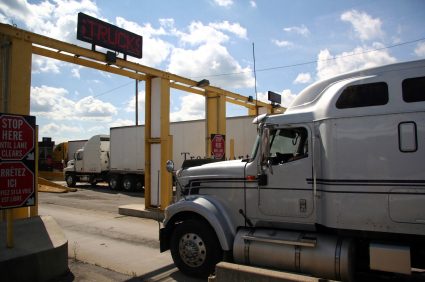
Trucking between the United States and Canada has always been a bit of a hassle. Complying with different regulations on either side of the border can range from confusing to downright maddening. Since the 9-11 attacks on the U.S., the situation for some drivers has become even more frustrating. Add to this conflicting rules from Uncle Sam regarding cabotage (the transportation of freight between two points within the same country), and it makes some drivers wish they had been an accountant rather than a trucker.
To clear up some misconceptions in this area, we spoke to Debbie Dent, a licensed customs broker based in Windsor, Ontario. She’s spent 30 years specializing in border issues. Currently she is director of compliance and customs in the consulting services division for Panalpina, a large freight forwarder, and she is an expert on the international movement of freight, between Canada and the U.S. or anywhere in the world.
Lockridge: There has been a thread on the ExpeditersOnline.com forum recently leading some drivers to believe the rules about hauling freight from Canada to the U.S. have changed. Is that really the case?
Dent: No, [but] the rules are sort of archaic and have been and are being reviewed, particularly in the discussions with Mexico and allowing the Mexican vehicles into the United States and Canada. Everything seems to be falling under scrutiny at this point. There are a number of government departments that sort of manage this whole thing, and some of it really comes down to the driver’s actual immigration status. If that driver is a Canadian, he cannot do a domestic move within the United States. If that movement is of an empty vehicle, just moving from one point to another for the purpose of loading or pickup, then that is allowed. But, if they are carrying actual freight, that’s the same rule that has been around forever — the driver, working within what we call the constraints of the INS (Immigration and Natural Service, now called U.S. Citizenship and Immigration Services) and work permits — he cannot do a domestic move. He can only do an international move, meaning a point from Canada to the United States; [and/or] a point from the United States back into Canada.
Lockridge: Is the driver’s citizenship status a bigger factor in cross border movements than where the truck originates?
Dent: It’s the driver’s immigration status. For example, if a driver from Canada had dual citizenship, he could in fact, potentially, do a move between a point in the United States to another point. But he can’t [under Customs rules] … using a vehicle that is only used for international transport, [which] means that the vehicle or equipment has not been duty-paid into the respective country. So, that sort of takes care of the equipment. The driver, then, his immigration status — if he is Canadian working for a Canadian company — he can only do a point from Canada to the United States and return back to Canada. The equipment, then, would not be entered or duty-paid into the United States.
Lockridge: So this basically boils down to where we have a case in which some rules from the Federal Motor Carrier Safety Administration conflict with rules from other parts of the federal government?
Dent: Exactly. They are expected to be pretty much uniform and agreeing with each other, but we do find that in certain instances, each has a definition to their specific rules.
Lockridge: Let me give you this example of a situation that has some drivers confused. It comes from U.S Customs Service and the Immigration and Naturalization Service (now know as the U.S. Customs and Border Protection Service and the U.S. Citizenship and Immigration Services, respectively). It says, and I am quoting, “ Generally, the use of Canadian-based vehicles for domestic movement of merchandise is prohibited. There is one exception. A domestic movement incidental to the immediate prior or subsequent engagement of a vehicle in international transportation is allowed. Incidental is defined as in the general direction of an export move or as part of the return movement to their base country. It includes a movement en route to the pick-up of an export move. For example, a Toronto, Ontario-based carrier transports merchandise originating in Toronto and terminating in Miami, Fla. The vehicle can then be used to pick up merchandise in Miami for delivery to St Louis, Mo., (a domestic move) where an export move will be picked up for delivery to Canada. The movement of merchandise from Miami to St Louis is considered incidental to the immediate prior or subsequent engagement of such vehicle in international transportation. The Canadian-based vehicle can also transport a domestic move in the general direction of an export move and then immediately return empty to Canada.†What’s your opinion on this example?
Dent: I’ll assume the goods destined for St. Louis were not on the truck when it left Canada, so that “incidental†move would be considered cabotage. Whether the truck is en route back to Canada or not, they are not allowed to do domestic pick-up or drop-off, as Canadian truck drivers. If that driver runs empty to better position himself to get a load, no problem. If he picks up in Miami and those goods are destined for St. Louis and he delivers there, it’s definitely against the rules. Now if there were two shipments on board [from Canada], one for Miami and one for St. Louis, and the driver does the one for Miami and then continues to St. Louis, delivers and returns empty, then there is no issue. Or if the driver has dual citizenship there’s no issue. Notice the use of the word vehicle, not driver [in this example]. The vehicle would be covered under customs laws, while the driver is covered under immigration laws.
Lockridge: Do you see any effort on the part of the U.S. government to harmonize these different regulations between FMCSA and other federal agencies?
Dent: All the rules are being sort of re-engineered based on new electronic transmission of data. You know, the old hard-copy signing of documents is going away, and all of these things are under a great deal of scrutiny to verify whether they are now meeting rules that sometimes have been around for years and years and years. And, some of these old rules are … being scrutinized to see if times have changed and are the rules keeping pace with the changes. Unfortunately, getting multiple government departments to talk has always been sort of a challenge, but it’s getting better as they start to share more information.
Lockridge: Well, I’m deeply shocked that getting government agencies to share information has been a problem.
Dent: Yeah, exactly. Now, for example, going into the United States with the e-Manifest and the ACE program, you are going to have all these multiple departments or government agencies getting information that is being extracted by this electronic transmission. So what you are going to have is not only drivers potentially at risk if they are pulled over for a roadside check or pulled over by a state trooper, you are going to have them potentially stopped at the border, based on the information that they have reporting electronically. Did they have a safety violation in one of the other states? Did they comply with correcting that? Reporting it properly? So, there are a lot of changes that will happen over the next several years just based on this new movement of electronic data now being shared by multiple government agencies.
Lockridge: So you’re saying, having the e-Manifest and the ACE system and such, should actually help driver compliance with these multiple and different regulations?
Dent: It’s going to force the driver to have all of these things in place – meeting all the rules and regulations, even for multiple departments or government agencies that traditionally did not stop that freight from entering into the United States. They are now going to be extracting their portion of the information from that electronic transmission.
Lockridge: Are there certain U.S. regulations … that maybe should take precedence over another agency’s regulations when it comes to these cross-border movements?
Dent: I don’t believe so. You still have equipment and the usage of that equipment and what it’s allowed to do. And then, you have the immigration status [regulations], which helps ensure that that the Canadian is not working in the United States potentially taking the job of the American, and vice versa. So, two different issues, both important in their own right – equipment and the immigration status of the individual driving.
Lockridge: Looking in your crystal ball, where do you see this ending up? Is it going to become more confusing or less confusing as time goes on?
Dent: I would think it’s going to become less confusing as more of the regulations and the rules, as they have been written maybe decades ago, are being now revamped or re-looked at just to meet today’s means of doing business. So, I think in the long run, things will improve and there will be a standard, and a uniformity, that we will see with this new technology development. Unfortunately, we’ve got to go through some transitioning growing pains to get there.
Lockridge: You mentioned about the e-Manifest system. Do you know when this is going to be fully phased in for all the Canadian-U.S. border crossings?
Dent: It is now located on 99 ports of entry between Canada and the United States. In some areas it's still in what we call “soft enforcement,†but it’s pretty much now mandatory in most locations and being done, except where there is an exception. An empty truck, for example, does not have to report electronically, yet. But, eventually those rules will change where even an empty truck — because there is a driver that they want some information on, or they want some information on that equipment — will even have to report even without having a shipment on board.
Lockridge: Any idea what that planned phase-in is for fully requiring the e-Manifest before any truck can do cross-border movements?
Dent: We really are waiting for some regulation announcements to enforce that. I applaud the U. S. government that they have taken what a “phase-in†approach. They understood that when they did this to the carrier community, that you had the individual that might only cross the border once in a year, and that person or that company needs to be aware of what the new rules and the regulations are. But, I would suspect somewhere in 2008 that soft approach will go away and there will be penalty action and refusal to enter if you don’t meet the compliance of mandatory advance cargo report.
Lockridge: Where do things stand when it comes to U.S. movements into Canada with an electronic manifest system?
Dent: The e-Manifest for Canada is being discussed. It looks like we are going to see something roll out in 2008 … that will be reciprocal. I know that the two governments have been speaking. We are hoping that the Canadians will put something out that is very similar to what the United States deployed so that for a trucking company … basically the same information data requirements will required. We are hoping that maybe Canada can take advantage of the United States having gone through all the setup and creating the wheel; let’s not re-create the wheel.
You can read what was said about cabotage on the EO forum at http://www.expeditersonline.com/dcforum/DCForumID1/6589.html
Evan Lockridge is a freelance writer and hosts the radio show Expediter Newsbreak.