

Streakn1
Veteran Expediter
I asked "What is it?" in an earlier thread. Here is the answer:
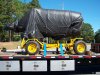
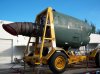
It is an engine off of a C-130 Hercules Cargo Plane. The cement mixer looking thing is actually the turbine mounted in a service stand. The engine is mounted to the plane at the back of the engine where the exhaust tube comes out. Unlike the jet engines which are shipped without their outer casings, this was shipped with them on. The prop and nose assembly were not shipped. This engine was enroute to be rebuilt.
Unlike hauling regular freight, expediters must deal with special needs freight on a daily basis. It never fails that something odd comes along that we all must try to secure safely before transporting. This was one of those cases.
The stand had no brakes on the wheels. The front wheels also turned for steering the stand. There were four small jackstands on each corner for stabilization rather than relying on the tires alone for support. Note also how the engine is mounted in the stand, at one end only. It is not supported at both ends like the jet engines we carry. We also had a high center of gravity to deal with, again unlike the jet engines that typically sit lower in their stands. We learned that this is how these engines are designed to be transported and hung on the plane.
After installing blocking, chains, and strapping in the right places, all made it to its destination safely and undamaged! This is definately more challenging than our days of hauling microwaves, refrigerators, and computer towers for the Fed! LOL
It is an engine off of a C-130 Hercules Cargo Plane. The cement mixer looking thing is actually the turbine mounted in a service stand. The engine is mounted to the plane at the back of the engine where the exhaust tube comes out. Unlike the jet engines which are shipped without their outer casings, this was shipped with them on. The prop and nose assembly were not shipped. This engine was enroute to be rebuilt.
Unlike hauling regular freight, expediters must deal with special needs freight on a daily basis. It never fails that something odd comes along that we all must try to secure safely before transporting. This was one of those cases.
The stand had no brakes on the wheels. The front wheels also turned for steering the stand. There were four small jackstands on each corner for stabilization rather than relying on the tires alone for support. Note also how the engine is mounted in the stand, at one end only. It is not supported at both ends like the jet engines we carry. We also had a high center of gravity to deal with, again unlike the jet engines that typically sit lower in their stands. We learned that this is how these engines are designed to be transported and hung on the plane.
After installing blocking, chains, and strapping in the right places, all made it to its destination safely and undamaged! This is definately more challenging than our days of hauling microwaves, refrigerators, and computer towers for the Fed! LOL
Attachments
Last edited:

