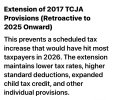
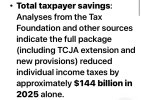
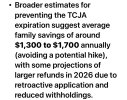
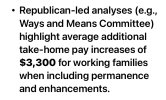
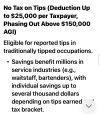
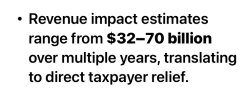
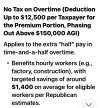
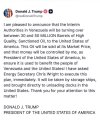
Does keeping the tax cuts in place instead of letting them expire help or hurt the middle class?
That's what I want to determine by looking at the FULL impact of ALL tax cuts, including those given to the billionaires.
Does having much lower gas prices help or hurt the middle class?
Everyone benefits from lower fuel prices, except the oil companies Trump wants to help with "Drill baby drill." If the cost of drilling exceeds the price they can get for the crude, drilling stops. Fuel prices are declining for supply and demand reasons. They keep discovering more and more of it. They keep getting more efficient at extracting it. And a slowing economy reduces the demand for fuel.
Does not having runaway inflation help or hurt the middle class?
Obviously, keeping inflation low is good for lower, middle, and upper class alike. But tagging inflation in a given month or year to a given president provides more fog than clarity.
Here's the annual inflation rate from 2019 through 2025:
2019 1.8%
2020 1.2%
2021 4.7%
2022 8.0%
2023 4.1%
2024 2.9%
2025 2.7%
Notice the trend. Inflation was below 2% in 2019 and 2020. In 2021 and 2022, it shot up to peak at 8.0%. The inflation rate then declined in the last three years.
The 2% inflation target is the official goal of the Federal Reserve (the Fed) and most other major central banks around the world. It is considered a "Goldilocks" number: not too high to disrupt the economy, but high enough to avoid dangerous stagnation.
With the benefit of hindsight, we can analyze the now-known inflation numbers and the events that caused it. The short story is the economy ground to a halt when government mandates closed businesses, schools, churches, imposed movement restrictions, etc. to fight COVID-19. The US Federal Reserve Bank responded by opening the liquidity floodgates (a/k/a printing money).
When they increase the amount of money in the economy, it makes it easier and cheaper for people to borrow and spend. When people and businesses have more cash to buy things, prices go up. Prices rise because there are more dollars competing for the same items. Put another way, sellers raise their prices because (1) people will pay them, and (2) sellers see their costs increasing and they need to make that back.
Those were amazing days. The government literally handed business people a ton of money at very low interest rates and they later forgave the loan, converting that money into a well-timed gift. My wife and I normally do not seek help from the government but when they forced us to close our gym, we were OK accepting the largess. The government also padded the pockets of individuals with previously unheard of unemployment pay. That resulted in a lot of people choosing to stay home because they did not need to work to make enough money to live on.
There are a lot of so-called business people in legal trouble now because they did not properly use or account for the many thousands of dollars of "free money" they received. You may know of some who spent a ton of this "free money" on vacations or goods they did not need and improperly purchased under the loan rules. You may have heard of others who gamed the system to gain vast sums of COVID-19 money they were not legally entitled to receive. While those legal problems are happening now, when the money was available, people freely spent the money, thereby providing the economic boost the Federal Reserve Bank hoped to provide.
The Federal Reserve Bank initiated massive liquidity injections starting in March 2020. This response included lowering interest rates to near zero and launching open-ended quantitative easing, where the Fed purchased trillions of dollars in Treasury and mortgage-backed securities to stabilize the economy. These actions began during the presidency of Donald Trump.
| Event | Date | President |
| First emergency rate cut (0.50%) | March 3, 2020 | Donald Trump |
| Rate cut to near zero and $700B QE launch | March 15, 2020 | Donald Trump |
| Open-ended QE and new credit facilities announced | March 23, 2020 | Donald Trump |
| Expansion of lending programs (up to $2.3T in loans) | April 9, 2020 | Donald Trump |
| Continued monthly asset purchases ($120B/month) | 2020 - 2021 | Donald Trump / Joe Biden |
It takes a while for the effects of such liquidity injections to fully manifest. That's why you see a lag between the actions and peak inflation.
Biden critics and Trump supporters are quick to blame Biden for inflation. But a rational analysis of the actual history and results undermine that view.
So, yes, lower inflation is good for everyone. But the cause of inflation is not easily pinned on a particular president. There are many moving parts in the economy and all of them are inflationary or deflationary in one way or another.
You may be interested to know that the Federal Reserve Bank recently changed it's policy to pump more money into the economy., It's called quantitative easing, which reverses the quantitative tightening policy it maintained until recently. If Trump gets his way and gets a Fed chair who wants to lower interest rate, that too will be inflationary because it make it easier for people to borrow and spend money.
When COVID was underway, the Fed treated it like an economic emergency and they poured trillions of dollars of new money into the economy. Today's quantitative easing actions are inflationary but more measured. But something else is going on in which the Fed is reactive, not proactive, and it could fire up inflation again.
Responding to Trump's heavy handed trade actions and military adventurism, many nations of the world are uniting against the US. Part of that includes the BRICS countries which are engaged in "de-dollarization." That's a major topic in itself. For this thread's purposes, I only talk about their purchasing and holding far fewer US Treasury bonds than they used to.
The US government finances its deficit spending by borrowing money. They borrow that money by selling bonds to other nations, financial institutions and individual investors. For decades, the central banks of other countries and financial institutions there freely bought these bonds because they were deemed a safe investment. The ready market for these bonds meant the US Treasury Department could offer them at favorable interest rates (the Treasury pays the interest to the bondholders, which is why the bondholders buy them).
But a secular change is now underway. Foreign countries, institutions and investors have drastically cut back on their US Treasury holdings. They are buying less of them and selling a lot of what they have in the bond market. This is driving up the cost the Treasury Department must pay -- the higher interest rate it must offer -- to get people to buy the bonds, so the US government can keep spending more money than it has. To counter this, the Trump administration (Treasury Department) has been selling shorter term bonds, which have lower interest rates.
In the past, they sold long-term bonds to lock in lower interest rates for 10, 20, and even 30 years. But reacting to current pressures, they're selling short term bonds which must be replaced sooner because they mature sooner. Just like an adjustable-rate home loan puts consumers at great risk if interest rates increase, so too with the US Treasury and these short-term bonds.
Treasury could easily sell longer term bonds, but they have to raise the interest rate to attract buyers in the now-diminished, anti-US market. You talk about lower interest rates. That's true to a point, but its' deeply concerning if you look at the big picture.
And it's deeply concerning to a whole lot of people and entities worldwide. This is precisely why the price of gold has skyrocketed in recent months. People worldwide, including foreign central banks, are losing faith in the US dollar. Foreign banks have been buying up gold literally by the ton because they want to be prepared for a US Dollar collapse. Until recently, central banks worldwide were net sellers of gold if they kept any at all. Now days, they are buying and holding tons of it in their vaults.
Pumping money into the economy is inflationary. So is the declining value of the dollar we now see. The inflation trend has been encouraging for the last three years, but I do not expect that to last. The US government is in deep, deep financial trouble, and people don't trust the dollar like they used to for that reason.
On the surface, low inflation and tax cuts and low interest rates all sound good, when viewed in isolation. But when viewed in the context of all the other moving parts of the global economy, I trust you can see that the simple questions you ask cannot be effectively answered with a simple yes or no answer.
They can absolutely be politically answered with a yes or no answer, but wise people look beyond that. Wise people are looking now at their gold holdings and other preparations for not a dollar that will decline, but a dollar that is declining now and has been for some time.
It's not just me saying this. Major investment advisor companies have made recent news by saying the time-honored 60/40 portfolio mix (60% stocks, 40% bonds) needs to change to 60% stocks, 20% gold, 20% bonds. As people heed this advice, the demand for gold will grow, further propelling the price higher (not because gold became more valuable, but because the dollar became weaker).
Wise people are also noticing that the amount of money the US government must borrow to fund its deficit spending countinues to increase and has reached dangerous levels. We now pay more in Treasury Bond and other borrowed-money interest than we pay to fund the entire Department of Defense. The number is curently at an all-time high of $38.5 trillion.
If interest rates tick up just a little bit, the amount of additional expense is unimaginable to ordinary people like you and me. I fear we are near a breaking point that will collapse or severely degrade the US dollar, and our purchasing power along with it.
Allow me to elaborate on the inflation thing just a bit. As an employer of people 30-40 years younger than me, I like to educate them about inflation and the dollar decline. I ask them, if you purchased a nice 3 bedroom house for $300,000, and you lived in it a while and it doubled in value to $600,000, are you then able to sell that house and buy a nice 6 bedroom home? They instantly understand what inflation means. Their next 3 bedroom home did not double in price because the asset increased in value. It doubled in price because the dollar declined in value.
I reinforce the lesson by stacking 5 quarters on the table, which represents minimum wage when I entered the workforce. Next to it I stack 56 quarters, representing Florida's minimum wage today. Again, they instantly see how inflation affects their lives.
When I was a young man, has someone told me $14 an hour would be the minimum wage, it would have been impossible to imagine. Just is it is impossible to imagine that minimume wage may be over $150 per hour in the future. Nevertheless, this is exactly what happened, and that was when America was still a strong nation, considered the "A shining city on a hill" (a phrase used by both Regan and Kennedy).
Is runaway inflation bad? Of course it is. But if you're counting on Trump to keep it low, you would be wise to reconsider. He is paving the way for increased inflation rates of historic proportions.
The other questions you asked are answered above.