Diesel Power Tuning Module
Product Description:
The Diesel Power CR Tuning Module installs between the fuel rail pressure sensor and the ECU (engine control unit). Installation is plug and play and takes about 5 minutes. This module works with any common rail system and can sense which sensor it is connected to. It only modifies the fuel rail pressure sensor signal to the ECU and no other signals. This “logical thinking” module does not necessarily always modify the signal to increase fuel supply. It can leave the fuel supply at normal levels as well. The fuel supply is increased by increasing the fuel injector pulse width and not by increasing fuel pressure. There is no signal or change to the fuel supply pumps, fuel supply pressures, turbo boost or other operating parameters. The module increases the injector pulse width (or length of time the injector sprays) based on fuel pressure change in the fuel rail. Not every change in fuel pressure triggers an increase of the injector pulse width and the addition of fuel. This is why the Diesel Power Tuning Module is fuel efficient. If you desire, the module is adjustable and can be run at lower settings providing less hp and torque increases. If you prefer to use the module only under certain load conditions, you can remove the unit and install a bypass to return to factory settings in the matter of a minute. More on running at different settings later.
Testing Parameters:
Test-driving conditions:
First leg of trip; From Tualatin OR taking I-5 north and Hwy 101 to first fueling stop at Ferndale WA (exit 263) with a daytime temperature of 50 degrees, no wind and partly sunny day. 302.8 miles of all highway driving taking on 12.4 gal of fuel for an average of 24.4 mpg. We consistently average 23.5 to 24.5 mpg highway mileage so I consider 24.4 normal.
Second leg of trip; I-5 north from Ferndale WA to Delta BC and back to Ferndale with weather conditions identical to first leg. 132.4 miles taking on 6.7 gal of fuel for an average of 19.76 mpg. Miles driven were a 50/50 mix of highway, stop and go and included the dyno power runs. The tuning module was installed for about 70% of these miles. Our normal mpg for these driving conditions (without the tuning module) has been 18-19 mpg.
Third leg of trip; I-5 south from Ferndale WA to Tualatin OR and directly to fuel station with a daytime temperature of 50 degrees, light wind and sunny conditions. 286.5 miles of highway driving taking on 11.4 gal of fuel for an average of 25.1 mpg.
Highway driving speeds: 63 and 68 mph
Vehicle: 03 Freightliner 140” 2500SHC 3.73 rear diff. 16” tires carrying approximately 800 pounds above vehicle weight (or about 5800 GVW) and 18,000 miles on odometer.
Fuel: #2 diesel with 20% bio mix
Air filter and intake assembly: Stock
Exhaust system from turbo back: Stock
Exhaust gas temperatures (EGT) were monitored with a pyrometer probe located in the exhaust manifold just in front of turbo inlet. An Ease Diagnostics scan tool was used to monitor rpm, engine coolant temperature, mph, air intake temperature, etc. The Ease Scan Tool is accurate enough to measure 1 degree changes in engine coolant temperature even on the slightest of grades.
Dyno test date: 2/14/05
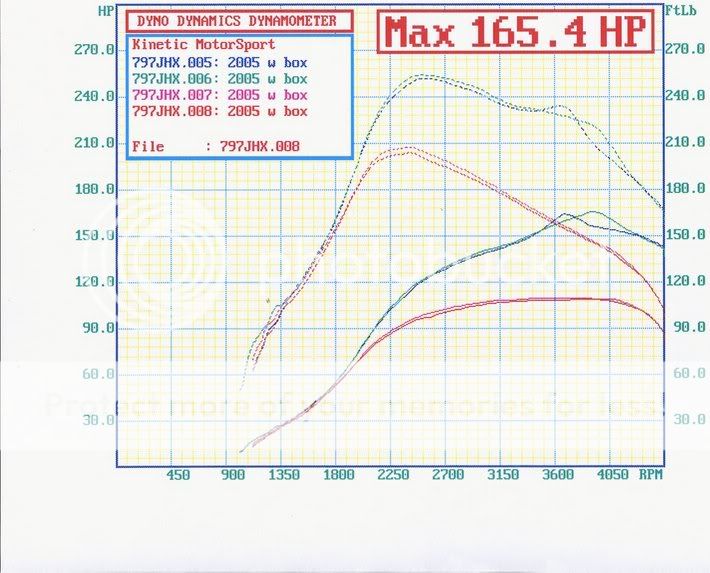
Number of dyno runs: 10 consisting of; 1 warm up run, 2 stock base line runs, 2 power runs in module settings 8 and A, 1 run to verify the prior setting A power run and to verify general run consistency, 2 power runs in module settings C and E, 1 power run in module setting B and 1 sustained power run for 1 minute plus under maximum dyno load in module setting B.
Gear in which dyno tests were performed: During dyno runs 1-9 the transmission was in 4th gear. During the sustained power run number 10, the transmission was in 3rd gear (since the transmission wants to up shift to the highest gear, you need to manually shift and hold in order to keep the transmission in the proper gear when running on the dyno)
Total time to make dyno runs: 50 minutes
Number of error codes set: None (except ABS and ASR due to no front wheels turning while on the dyno and the ASR sensing a traction imbalance while on the dyno rollers)
Number of error codes in 800+ miles of driving: None
Type of dyno: Dyno Dynamics Chassis Dyno
Types of vehicles run on this dyno: Ford Powerstrokes, Dodge Cummins, VW Jetta, etc. When we arrived they had just finished running a 05 Mustang at 485 hp (it sounded awesome).
Vehicles tested using the Diesel Power Tuning Modules: 1 Sprinter and 2 - 04 Jettas
Dyno time including set-up: 2 hours, 1 hour for the Jettas and 1 for our Sprinter
Visual exhaust smoke during power and sustained dyno runs: None
Engine EGT (exhaust gas temperature) and ECT (engine coolant temperature) under normal stock highway conditions (the trip up):
Idle when fully warmed up; EGT 325 degrees, ECT 180 degrees
58 mph; EGT 575 degrees, ECT 183 degrees
63 mph; EGT 600 degrees, ECT 185 degrees
68 mph; EGT 625 degrees, ECT 185 degrees
68 mph on moderate hills; EGT 725 degrees, ECT 187 degrees
60 mph on a very long and very steep hill; EGT 875 degrees, ECT 189 degrees
Engine EGT and ECT under highway conditions with the tuning module installed (the trip back):
Idle when fully warmed up; EGT 325 degrees, ECT 180 degrees
58 mph; EGT 575 degrees, ECT 183 degrees
63 mph; EGT 600 degrees, ECT 185 degrees
68 mph; EGT 625 degrees, ECT 185 degrees
68 mph on moderate hills; EGT 725 degrees, ECT 187 degrees
Engine EGT and ECT during dyno runs with tuning module installed: Found EGT to run between 325 at idle and 625 by the end of the each run. Since runs were short, the EGT really did not have time to build. ECT ran between 180 at idle and 187 depending on module setting. On the sustained 1-minute plus power run found EGT stabilized at 950 degrees with the ECT stabilizing at 194 degrees.
Sustained load description supplied by dyno technician: The dyno produces what is called tractive effort which creates sustained load for sustained runs when testing higher powered diesels i.e. the Cummins. For our test the tractive effort was set at 1175 pounds, which is the maximum setting used for diesels producing hundreds and hundreds of pounds of torque (meaning 400, 500, 600 and more). This was the most severe test that you could simulate and the Sprinter took it unfazed.
Definition of safe EGT’s for a quality built diesel engine supplied by dyno technician: Under sustained loads, you can safely operate at EGT’s of 900-1200 degrees for extended periods of time. EGT’s of 1300 degrees can be sustained under load for 1 minute with a 5 minute cool down between runs. EGT’s over 1300 can be sustained under load for 15 second bursts with cool downs between runs.
HP and Torque results AT REAR WHEEL (which is different than static engine specs):
Stock base line run
MPH RPM HP Torque
43.5 2037 59.7 154
49.7 2328 79.8 180
55.9 2619 95 191
62.1 2910 108.3 196
72.1 3376 121.2 189
HP and Torque results AT THE REAR WHEEL with Diesel Power CR Tuning Module installed in the B setting and under a sustained load:
MPH RPM HP Torque HP% & Torque% Increase
43.5 2037 82.5 213 27.6% 27.7%
49.7 2328 100.9 228 18.2% 21.0%
55.9 2619 117.2 233 18.9% 18.0%
62.1 2910 128.2 231 15.5% 15.2%
72.1 3376 150.1 233 19.3% 18.9%
Note: I will conduct lower hp and torque vs. lower mph tests on our dyno at a later date. Additional towing tests will also be conducted.
As you can see during the dyno run in the B setting, starting at 50 mph the Diesel Power CR Tuning Module produced torque that stayed flatter, stronger and longer than the stock run. The “B” run had approximately 18% more torque and varied only 5 pounds throughout a 1000 rpm and 22 mph increase vs. the 16 pound variance during the stock run. You can also see a strong hp and torque increase in the mid-range mph and rpm acceleration.
Fuel economy increase at highway speeds: .7 mpg
Average HP and torque increase: HP 17.98% and torque 18.28%
Drivability:
The increase in performance when using the Diesel Power CR Tuning Module is very subtle. When giving slightly more pedal than you may normally, you will feel more pep. On hills you will notice the increase in torque. You will find less pedal change is needed to maintain constant speed as you climb the hill. It feels like your Sprinter glides up hills with less effort. This is not a lay me back raw power powerchip. Overall drivability is excellent and really not much different than stock. It takes very little getting used to.
Pricing: $529.00 plus shipping. The module has a 3 year warranty.
Conclusions, Explanations and Comments:
The Diesel Power CR Tuning Module has 16 settings (0123456789ABCDEF) allowing optimum vehicle specific performance. The module is adjustable and can be run at lower or higher settings providing less or more hp and torque increases. The dyno run in the #8 setting produced approximately 8% more hp and torque while the run in the A setting produced an increase of approximately 15%. Curiously, when running in the C and E settings, no additional hp or torque was gained. This is an indicator that, with the exception of the fuel injector pulse width, the Sprinter’s ECU is in control and will not allow the engine to operate outside acceptable operating parameters. Even in the C and E settings, there was no visible exhaust smoke. This is a very important point. It indicates that the fuel mixture was not running rich. It is also an indication that the mixture was still being controlled by the ECU and is within acceptable limits. Since the Diesel Power CR Tuning Module does not produce smoke when used on the Sprinter, the long-term effects of carbon build up in the EGR system, turbo and other systems should be negligible if any.
During my trip to visit Diesel Power NA, I pulled a very long and very steep hill at 60 mph under the stock configuration. During that climb, the EGT was 875 degrees and the ECT was 189 degrees. During the final sustained load dyno run with the module in the B setting, the EGT was 950 degrees and the ECT was 194 degrees. This represents such a small difference in EGT and ECT as compared to the significant difference in loading conditions that I do not believe overheating or engine damage will occur under heavy load conditions. On a 90 or 100 degree day the EGT and ECT would naturally be higher but still within the safe operating limits. Last summer I pulled our 5800 pound boat and trailer up the same stretch of I-5 on a 103 degree day and had absolutely no performance problems in the stock configuration. I do not believe the added performance of the Diesel Power CR Tuning Module would have created the situation of exceeding the safe operating limits of the Sprinter under those extreme circumstances. If I would have been using the module and decided I was exceeding the safe limits, I could have pulled over, easily replaced the module with the by-pass and continued on my merry way in the stock configuration. Could there be problems using this module at a GVW of 8000 pounds towing another 5000 while pulling the Grapevine or Cabbage Hill (I-84 eastern Oregon) on a 110 degree day? Possibly, but under these extreme conditions you just might have a problem in the stock configuration although I didn’t on a 103 degree day. I would recommend monitoring the EGT under this or a similar heavy load situation.
I realize this is not the most scientific of tests but I believe they are accurate enough to feel confident in selling this product. I am not done testing the module. I will be performing additional dyno tests to verify torque and horsepower increases at sustained highway speeds, running real life towing tests and more fuel economy checks under all conditions. For me, the most important test will be towing 5800 pounds up a long steep grade, which I am planning to do.
The Diesel Power engineer in Germany recommended a module setting of B for the Sprinter, which he indicated would result in a 20% increase in performance. Our dyno tests verified the accuracy of his recommendation. This indicates consistent factory testing by Diesel Power, knowledge of their product and integrity of product claims.
Diesel Power only makes tuning modules for diesels. They choose to specialize in diesel technology and as a result they have developed a quality product that is TUV and CE certified. Diesel Power has sold over 100,000 units worldwide with many being installed on the Sprinter. There are differences between the European and North American Sprinter but in general they share many common systems. Diesel Power reports no long term affects when using their CR Tuning Module on the Sprinter. Diesel Power makes products for many of the late model diesels found in the US today. If you have any questions concerning the CR Tuning Module or other Diesel Power products, let me know and I will be happy to help.
Thanks, John Bendit
Sprinter Store
sprinterstore.com
A division of Upscale Automotive, Inc.
19460 SW 89th Ave.
Tualatin, OR 97062
503-692-0846